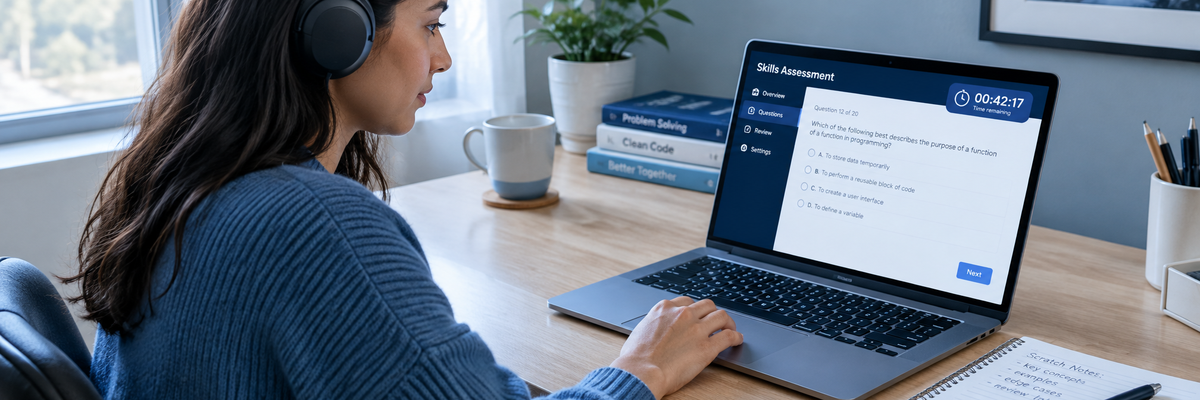
You sent in an application and got a reply the same day. It wasn't an interview request. It was a link to a timed test.
This is becoming standard. Before many employers will talk to you, they want to see something measurable: how you reason, how you prioritize, how you handle a realistic version of the work. Understanding what these assessments actually measure can make the difference between a score that moves you forward and one that quietly ends your candidacy.
Some of these tests are straightforward. Typing and computer proficiency checks measure whether you can work at the speed the job requires. Technical assessments test the specific skills the role is built around. Job simulations put you in a version of the day-to-day work and grade how you handle it. Others are less obvious—numerical and verbal reasoning tests measure how you interpret data and written information under time pressure, situational judgment tests present workplace scenarios and ask you to choose a response, and personality or behavioral assessments look at work style rather than ability.
What ties all of them together is a legal expectation that they be job-related. Federal law on employment testing is clear that selection procedures should measure what the job actually requires, and that using tests in a discriminatory way is prohibited.[1] The U.S. Office of Personnel Management, which runs assessments for federal hiring, also publishes preparation guidance for candidates taking its USA Hire assessments, including familiarizing yourself with the test format before you begin.[2] That's worth borrowing as a general habit: know the format before the clock starts.
Practically, that means a few things. Read the instructions all the way through before answering anything—timed tests punish people who skim. Confirm your tech works before you start: a stable connection, a working webcam if the test is proctored, and a quiet space without interruptions. Practice the type of reasoning or skills exercise you'll face rather than practicing generic interview answers. And note whether calculators, notes, or scratch paper are permitted, because using them when you aren't supposed to can invalidate your result.
One more thing worth knowing: if you're asked to take an assessment as part of a process and the content seems to have no connection to the job at all, that's a legitimate question to raise with the employer. Assessments are supposed to be tied to the role.
Ready to walk into your next assessment prepared? Here's your action plan: Ask what type of assessment it is and how long it takes. Confirm your tech and workspace the day before. Do one practice exercise in that format so the interface feels familiar. Read every instruction before your timer starts.
Head over to our homepage (or click the home button above) and use our advanced job search toolbar. Type in the kind of job you're looking for and where you want to work… then click "view jobs."
Pre-employment assessments are increasingly the first real filter in hiring, and they measure specific things—reasoning, technical skill, judgment, work style. Employers are expected to keep them job-related, and federal anti-discrimination law applies to how they're used. Prepare for the format, not just the content, and you'll go in far less rattled.