You found a federal job you're qualified for. You wrote a resume. You applied. You heard nothing.
Almost everyone who applies to the federal government for the first time has this experience, and it's rarely because they weren't qualified. It's because the federal process works differently from anything in the private sector, and the announcement itself tells you the rules if you know where to look.
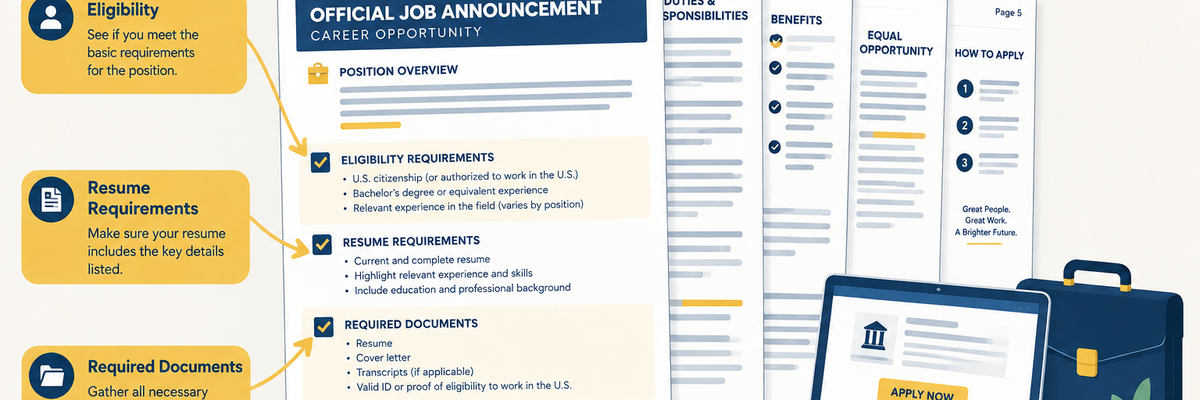
Everything starts with an account on USAJOBS, the government's official hiring site, where every federal opening is posted. From there, the process follows a specific sequence: you search, you confirm you meet the eligibility requirements, you read the announcement carefully, you submit the required documents, and in many cases you complete an occupational questionnaire or additional assessment before your application is even reviewed.[1] Each of those steps is a filter, and skipping one can end your application without anyone reading a word.
The single biggest reason applicants get eliminated is misreading eligibility. Federal announcements specify who may apply—current federal employees, the public, students, veterans with preference, and other categories—and applying when you don't fall into a listed category usually means your application is never considered, no matter how strong it is. Read that section first, before you spend hours on anything else.
The second most common mistake is the resume. A federal resume isn't the one-page version most private-sector candidates use. Federal HR specialists need documented hours, dates, and specific duties to determine whether you meet the qualification standard, which is why federal resume guidance recommends including far more detail than a typical resume would.[2] If your resume doesn't show the required experience in the format the announcement asks for, you can be rated ineligible on paper.
Then there's the occupational questionnaire. It's a set of self-assessment questions tied to the job's requirements, and it can carry real weight in how you're rated. Answer honestly and specifically rather than maximally—if you claim experience you can't describe in an interview, that shows. Where an assessment follows the questionnaire, treat it the way you'd treat any skills test and prepare for the format in advance.
One habit that helps more than anything: keep every document ready before you start. Transcripts, veteran documentation if applicable, and any required forms are commonly requested, and an incomplete submission is often unrecoverable.
Ready to apply to a federal job without getting filtered out on a technicality? Here's your action plan: Create your USAJOBS account and complete your profile. Read the eligibility section of any announcement before anything else. Build a detailed federal-format resume showing hours, dates, and duties. Gather your documents before you begin the application.
Head over to our homepage (or click the home button above) and use our advanced job search toolbar. Type in the kind of job you're looking for and where you want to work… then click "view jobs."
The federal application process is structured and unforgiving of shortcuts: eligibility, announcement instructions, resume format, required documents, and questionnaires each act as a gate. None of it is a judgment on your ability. Learn the language of the announcement, and your qualifications finally get seen.