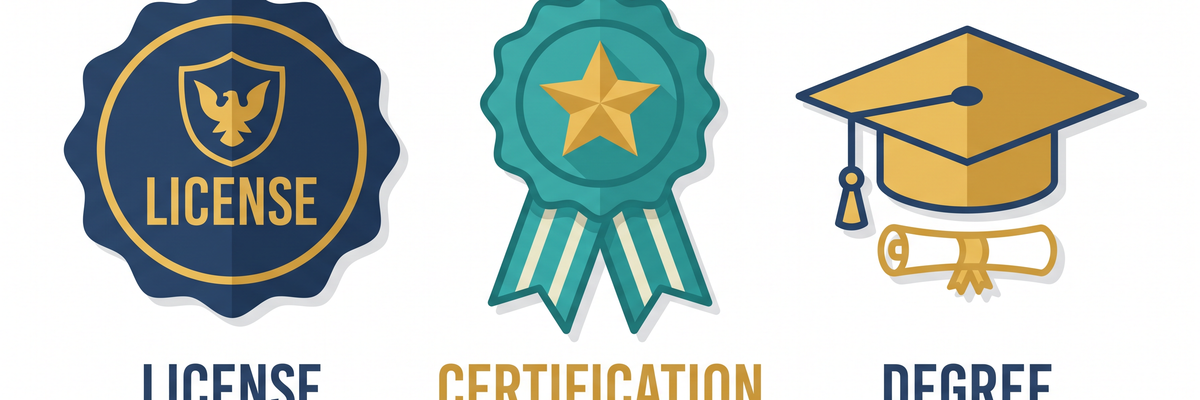
A lot of job seekers use the words "license," "certification," and "degree" interchangeably. But they are not the same thing, and confusing them can seriously derail your career planning.
Today, FindYourJobNow.com is clearing up exactly what each of these credentials means and how to figure out which one your target career actually requires.
A license is a legal requirement, typically issued and regulated by a state government, that permits you to practice a specific profession. Licensing requirements vary significantly by occupation and, importantly, by state.[1] This means the exact same job might require a license in one state and not require one in another, or the specific requirements to get licensed might differ from state to state even within the same profession.
A certification, on the other hand, is typically offered by a professional organization or industry body rather than a government agency, and in most cases it is not legally required to practice in the field.[1] Certifications generally demonstrate a specific level of knowledge or skill and can strengthen your resume and credibility, but skipping one usually won't prevent you from legally working in most fields, unlike a required license.
A degree is an academic credential earned through a college or university, and whether one is required, preferred, or not particularly relevant depends entirely on the specific occupation and even the specific employer within that occupation.
So how do you figure out which of these applies to the career you're pursuing? Start by checking whether your target occupation requires state licensing. CareerOneStop maintains a searchable License Finder tool that lets you look up occupational licensing requirements specific to your state, which can save you from a confusing patchwork of research across multiple government websites.[1] This is especially important because licensing requirements can catch people off guard, particularly if they're considering relocating to a different state where the requirements differ from where they currently live or trained.
Once you understand licensing, look into whether relevant certifications exist for your field. CareerOneStop also provides a searchable Certification Finder specifically for this purpose, allowing you to see what certifications are common or valuable in a given occupation and industry.[1] Even when certifications aren't legally required, having a well-recognized one can meaningfully differentiate you from other candidates in a competitive field.
Finally, check the Bureau of Labor Statistics Occupational Outlook Handbook for education and training requirements specific to your career, since this gives you the broader context of what employers typically expect, separate from strictly legal licensing requirements.[2]
Ready to identify exactly what credential your career actually requires? Here's your action plan: Look up whether your target occupation requires a state license, and check the specific requirements for your state. Search for relevant certifications that could strengthen your candidacy even if they're not required. Review the BLS Occupational Outlook Handbook for broader education expectations. Don't assume a degree is always the answer.
Head over to our homepage (or click the home button above) and use our advanced job search toolbar. Type in the kind of job you're looking for and where you want to work… then click "view jobs."
Licenses, certifications, and degrees are not interchangeable. Licensing is a legal requirement that varies by state and occupation, certifications typically come from professional organizations and are often optional, and degrees depend heavily on the specific career and employer. Use tools like CareerOneStop's License and Certification Finders to get clarity before you invest time or money into the wrong credential.
[1] CareerOneStop — License Finder
[2] Bureau of Labor Statistics — Occupational Outlook Handbook