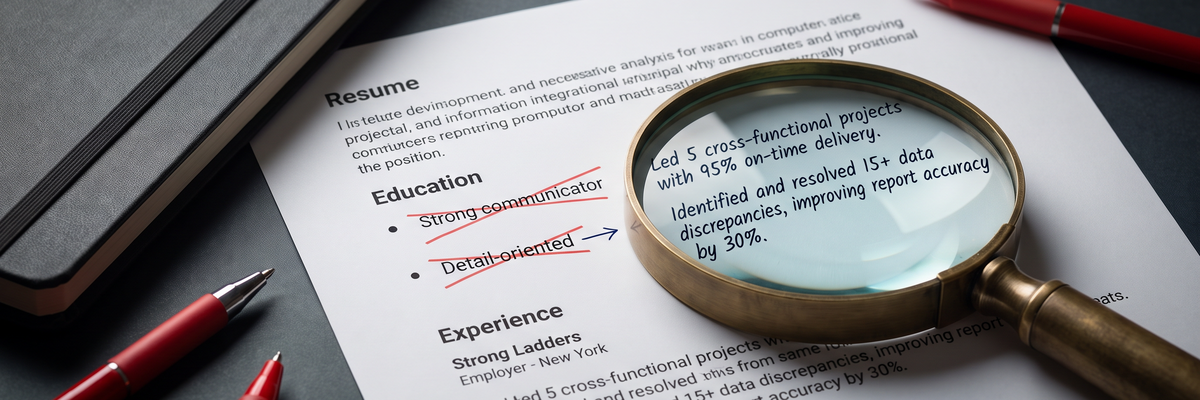
Take a look at your resume right now. How many of your bullet points are just adjectives?
"Strong communicator." "Detail-oriented." "Excellent leadership skills."
Here's the problem: everyone writes that. And employers have stopped believing it.
Today, FindYourJobNow.com is showing you why showing beats telling every single time, and exactly how to rewrite your resume to prove your skills instead of just naming them.
According to NACE research and hiring managers surveyed consistently, listing a skill isn't enough. Candidates need to show a specific example of using it.[1] This isn't a minor stylistic preference. It's a fundamental shift in what actually gets you noticed. When a hiring manager reads "strong communicator" on a resume, they've read that exact phrase hundreds of times from candidates who may or may not actually be strong communicators. It carries almost no information. It's noise.
What does carry information is a specific, concrete example. Compare these two bullet points: "Strong communicator" versus "Presented quarterly performance data to a room of 40 senior leaders, translating complex metrics into three clear takeaways that shaped the following quarter's strategy." The second one doesn't even use the word "communicator," and yet it proves communication skill far more convincingly than the label ever could.
This is what's sometimes called the "show, don't tell" principle, and it applies to every skill category on your resume. Instead of "team player," describe a specific project where you collaborated with others and what the team accomplished together. Instead of "detail-oriented," describe a time your attention to detail caught an error or improved quality, and quantify the impact if you can. Instead of "leadership skills," describe a specific instance where you led a project or a team and what the outcome was.
Here's a simple exercise to apply this across your whole resume. Go through every bullet point and ask yourself: is this a label or is this evidence? A label is a trait or skill stated as an adjective with no supporting detail. Evidence is a specific action paired with a specific, ideally measurable, result. Rewrite every label into evidence using this basic structure: what did you do, in what context, and what happened because of it.
This approach matters even more in interviews than it does on paper. When an interviewer asks "tell me about your leadership experience," the worst possible answer is "I'm a natural leader who people gravitate toward." The best answer walks through a real situation using the STAR method, Situation, Task, Action, Result, so the interviewer walks away with a concrete story rather than a vague self-description.
Think of it this way: labels ask the employer to trust you. Evidence gives them a reason to. In a competitive job market where hiring managers are reviewing dozens of similar-sounding resumes, evidence is what separates the candidates who get called back from the candidates who blend into the pile.
Ready to turn your labels into evidence? Here's your action plan: Print out your current resume. Circle every adjective or skill claim that isn't backed by a specific example. For each one, write a new bullet point that describes a real situation, a specific action you took, and a measurable result. Replace the old bullets with the new ones.
Head over to our homepage (or click the home button above) and use our advanced job search toolbar. Type in the kind of job you're looking for and where you want to work… then click "view jobs."
NACE research and hiring managers consistently agree that listing a skill simply isn't enough. Candidates need to show a specific example of actually using it. Labels ask an employer to trust you. Evidence gives them a real reason to. Go through your resume, replace every unsupported claim with a concrete story, and watch how differently your application reads.
[1] NACE — The High-Impact Skills College Students Should Showcase on Their Resumes